Client Portal
Get a Quote

UA is committed to collaborating with and assisting our clients to achieve and surpass their financial goals. If you're considering your next move, be sure to contact us today!
X
The macroeconomic landscape evolved positively for growth oriented assets in the third quarter. This was largely driven by increased capital expenditures in artificial intelligence (AI) and defense and shift towards more accommodative monetary policies. Central banks, including the Federal Reserve, European Central Bank (ECB), and Reserve Bank of Australia (RBA), all responded to softening labour market conditions and indications that tariff-induced inflation pressures will likely be less than previously feared by adopting more dovish stances. Stabilising global government bond yields backdrop, tightening credit spreads, and low equity market volatility, in turn, reinforced and fuelled investor sentiment as the quarter progressed. Indications of a U.S. and AI led global productivity revival also boosted sentiment and expectations of future growth.
Figure 1: The US is leading a global productivity revival
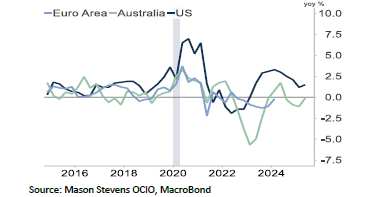
Corporate earnings further supported the positive outlook. During the Q2 2025 earnings season, over 80% of S&P 500 companies exceeded consensus estimates and maintained strong guidance. The technology sector continued to lead, with hyper scalers surpassing expectations in terms of AI related investment alongside robust revenue and free cash flow growth. This suggests a fundamentally driven rally and capex cycle, distinct from speculative trends seen in previous eras, most notably the Tech Bubble of the early 2000s.
Traditional economic metrics may not fully capture the extent of the current capex cycle. Investments in semiconductors and cloud services are often classified as intermediate goods meaning they are excluded from conventional final GDP calculations. Goldman Sachs estimates that AI-related investments and associated productivity gains could contribute an additional 0.5-0.7% a year to real GDP growth; a significant increase considering historical trend U.S. GDP growth of 1.5-2% a year. This underscores the importance of I as a long-term driver of economic and investment outcomes.
Geopolitical competition is influencing the economic cycle as industrial policies in the U.S. have prompted reactionary investments in China and Europe, particularly in areas related to national security and strategic technology. This has led to a synchronised fiscal impulse across major economies. Despite persistent tariff uncertainties, the net effect of the 2025 global policy mix has been a combination of strong growth and moderate inflation, which is a favourable environment for risk assets.
Looking forward, growth assets remain a focal point, with opportunities for benchmark outperformance spread across Australian and global equities and private credit. Within growth alternatives we have a preference for gold and private select equity managers. We maintain a neutral duration exposure. We are also monitoring developments in private credit markets closely while maintaining a modest exposure in a combination of listed and unlisted holdings.
From a cyclical standpoint, the investment themes we are currently focused on include small and mid-cap equities, momentum-driven equity strategies, U.S. banks, U.S. industrials, rare earths miners, and uranium. We also see opportunities for compelling active and diversifying strategies in gold, quantitatively driven and long/short equity approaches, private equity, and global healthcare.
The primary risks to our investment thesis include a potential slowdown in AI-driven capital expenditures, a delayed onset of tariff-induced inflation as we head into 2026 and narrow equity market breadth. Further labour market deterioration could also challenge the current market trajectory. Recent distortions in U.S. labour market data, compounded by the disruptive effects of Trump’s trade, fiscal and immigration policies have made assessing U.S. labour markets more challenging. The inflation outlook is similarly hard to forecast, due to the frontloading of imports in response to tariffs, which could lead to accelerated inflation in the coming years.
Overall, the macroeconomic and investment environment presents a blend of supportive and cautionary signals. Accommodative monetary policy, robust corporate earnings, and AI-driven productivity gains offer a constructive backdrop. However, persistent uncertainties around labour markets, inflation dynamics, and market concentration argue for a measured approach. We currently see a modestly risk-on stance as appropriate, provided portfolios remain well diversified across asset classes, geographies, sectors, managers, and investment styles.


Important Information: This content is issued by Mason Stevens Asset Management Pty Limited, ABN 92 141 447 654 (MSAM).MSAM is a corporate authorised representative (CAR 461312) of Mason Stevens Limited, ABN 91 141 447207, AFSL 351578 (Mason Stevens). The information provided is of a general nature only and does not have regard to any individual’s personal objectives, financial situation, or needs. You should consider this information, along with all your other investments and strategies when assessing the appropriateness of the information to your individual circumstances. MSAM encourages seeking specific professional advice from a licensed financial adviser before making a decision to transact in relation to any investment, security, or strategy. Investment in securities including derivatives involves risks. Securities by nature will rise and fall and therefore past performance is not a reliable indicator of future performance. MSAM and its associates and their respective directors and other staff each declare that they may hold interests in securities and/or earn fees or other benefits from transactions arising as a result of information contained inthis communication. MSAM ensures that the information provided in this communication is as accurate and complete as possible but does not warrant itsaccuracy or reliability. References made to any third party, or their data is based on information that Mason Stevens believes to be true and accurate asat the date of this communication but is without independent verification. Opinions and or information may change without notice and Mason Stevens isnot obliged to update you if the information changes. Mason Stevens and its associated companies, authorised representatives, agents, and employeesexclude to the full extent by law, liability of whatever kind, including negligence, contract, fiduciary duties or otherwise, to investors or anyone else inrespect of any loss or damage, including indirect or consequential loss or damage, foreseeable or not, arising from or in connection with this information.
UA is committed to collaborating with and assisting our clients to achieve and surpass their financial goals. If you're considering your next move, be sure to contact us today!
X